
ESG investing in practice
Keep ESG reporting reliable. For financial institutions, the challenge is keeping ESG classification and reporting reliable while SFDR and CSRD keep changing.
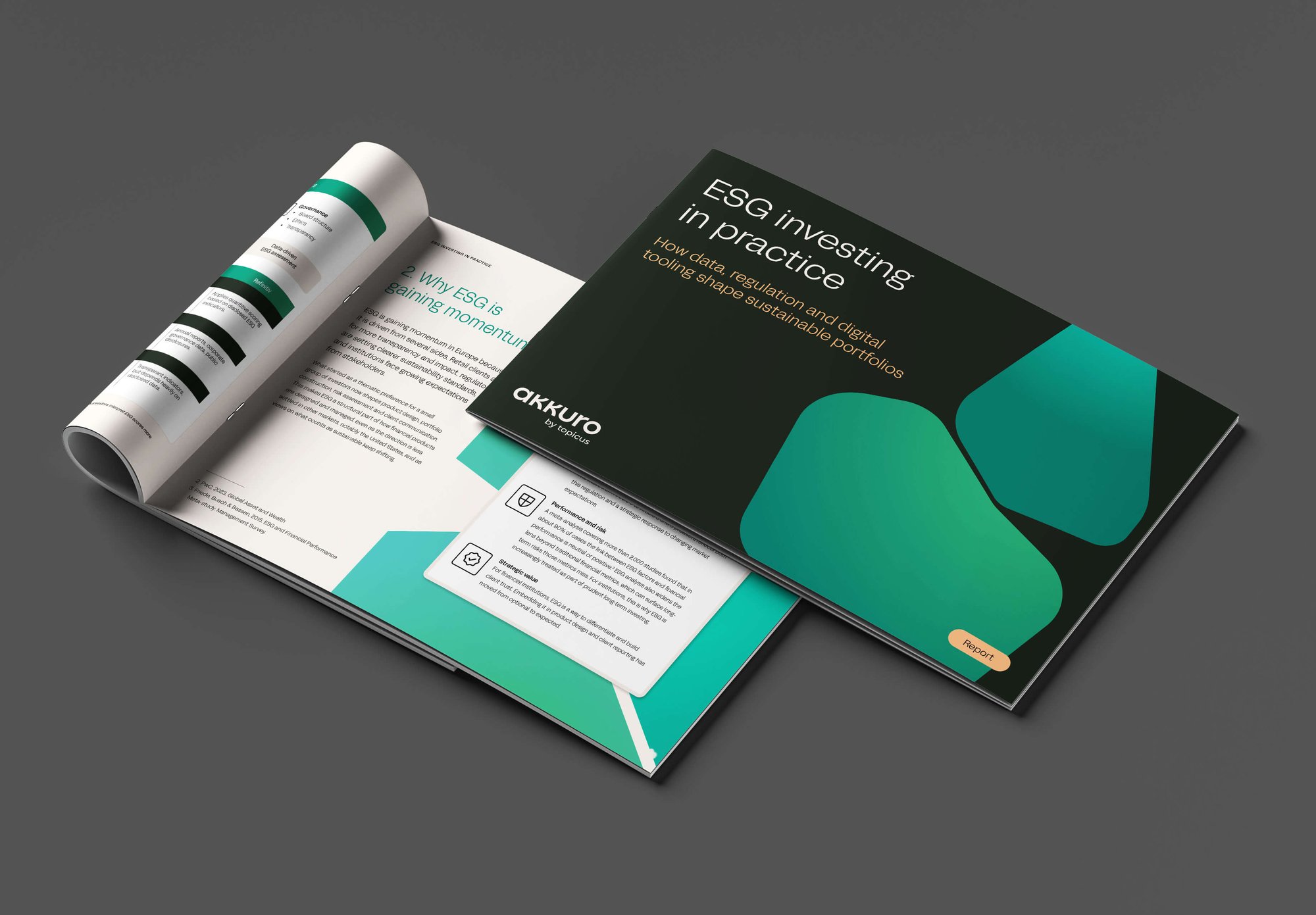
Covering instrument-level data, SFDR tooling and preference-aligned reporting, the report includes a maturity model to assess where your institution stands and how to reach the next level.
Please fill in your email to get the report.

Share


Sustainability is now part of how financial institutions build, classify and report on savings and investment portfolios. At the same time, the rules keep changing: the Omnibus I Directive has reshaped the scope of CSRD, and SFDR is moving towards three new product categories. In our report, “ESG investing in practice: How data, regulation and digital tooling shape sustainable portfolios”, we look at how institutions can make ESG work in day-to-day operations.
Summary
In “ESG investing in practice”, Frank Schooneveldt, Managing Director of Akkuro Savings & Investments, examines how ESG is integrated into savings and investment portfolios, with a focus on regulation, data and technology. The report explains why consistent, instrument-level data and adaptable reporting frameworks are becoming essential for accurate classification, reporting and oversight. Download the report to learn how to make ESG integration credible and repeatable.